The Wedding Film Guide
Wedding Videography Packages Explained: What Should Be Included?
How to compare coverage, filmmakers, professional audio, finished films, postproduction, delivery, and optional additions without relying on package names alone.
What should a wedding videography package include?
A clearly defined wedding videography package should explain the coverage period, number of filmmakers, camera and audio plan, finished films, postproduction, delivery expectations, travel or overtime policies, and any services that cost extra.
The package name itself tells you very little.
Terms such as essential, premium, cinematic, and full day are marketing descriptions rather than universal industry standards. Two studios can use the same words while offering substantially different coverage and finished work.
Compare wedding videography packages by what will be preserved and delivered—not simply by the hours or equipment listed.
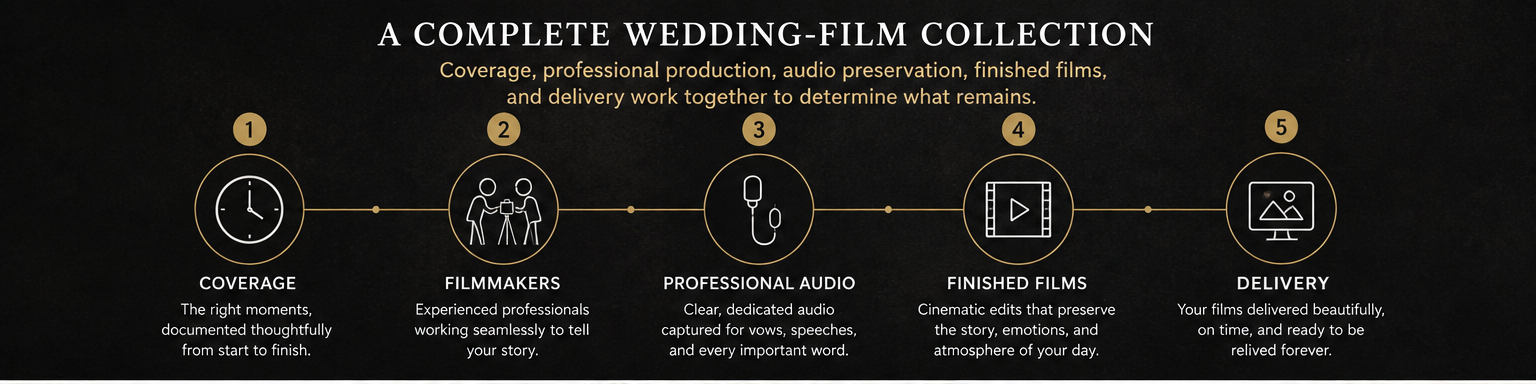
Many filmmakers use the word “package.” Palmer Weddings uses collection because the service brings together coverage, professional audio, multiple perspectives, and finished films as one coordinated experience.
The essential framework
The core components of a wedding video package
01
Coverage
When filming begins, when it ends, which events are included, and how overtime works.
02
Filmmakers
Who will be present, how many team members are included, and what each person contributes.
03
Camera plan
How ceremonies, reactions, speeches, and simultaneous moments will be covered.
04
Professional audio
How vows, the officiant, readings, musicians, and speeches will be recorded and backed up.
05
Finished films
The exact films included, their purpose, approximate scope, and delivery format.
06
Postproduction and delivery
Editing, sound, music, color, revisions, turnaround, and how the final work is delivered.
Why wedding videography packages are difficult to compare
Two proposals may both promise eight hours of coverage and a cinematic wedding film.
One may include one filmmaker, one short highlight, limited ceremony audio, and no complete event films.
Another may include several intentional camera perspectives, dedicated microphones, independent audio backups, a longer narrative film, a complete ceremony edit, and professionally finished speeches.
Two packages can look similar at first glance
Package A
- Eight hours of coverage
- One filmmaker
- One short highlight film
- Ambient or limited audio
- No complete ceremony film
Package B
- Eight hours of coverage
- A planned multi-perspective production
- Dedicated and backup audio sources
- A narrative wedding film
- Complete ceremony and speech preservation
The same number of hours does not create the same finished result.
This is also why the cost of a wedding videographer can vary significantly. The production scope, audio plan, finished films, and depth of postproduction may be entirely different.
Coverage hours: what does the timeline actually include?
Coverage time is one of the easiest package details to compare, but it is often misunderstood.
Ask:
- When does coverage begin?
- When is the team scheduled to leave?
- Does setup or travel between locations count toward coverage?
- Is coverage continuous?
- How is overtime approved and billed?
- Are welcome events or rehearsal coverage separate?
“Full-day coverage” has no universal definition. It may mean a fixed number of hours, coverage through a specific reception event, or a flexible timeline with an established limit.
The beginning of the day may preserve anticipation, family interactions, personal letters, attire, and private vows. Later coverage may preserve speeches, traditions, open dancing, and the final energy of the celebration.
More hours are valuable only when those hours support the moments and finished films that matter to you.
How many filmmakers should be included?
A package should state how many filmmakers will be present and whether the listed team is guaranteed.
An additional filmmaker may be useful when partners prepare in separate locations, events happen simultaneously, the venue is large, the ceremony has several entrances or traditions, or the collection includes broader guest and family coverage.
One filmmaker may be appropriate for a smaller, simplified celebration. A larger crew may be appropriate for a multi-location or multi-day production.
More filmmakers are not automatically better. The crew should match the timeline, locations, simultaneous moments, and intended films.
Ask who will actually film the wedding, whether the portfolio represents that team’s work, and how each filmmaker contributes. Our complete questions to ask a wedding videographer guide explains what to clarify before signing.
How many cameras are included—and what will they preserve?
The number of cameras matters less than the purpose of each camera.
During a ceremony, one camera may preserve the processional while another preserves the reaction at the altar. A wider perspective may show the complete setting, while an additional angle may preserve parents, readers, musicians, or cultural traditions.
A ceremony plan may need to account for:
- The entrance and processional
- Each partner during the vows
- The officiant
- A complete wide perspective
- Parents and guest reactions
- Readers, musicians, and traditions
- The recessional
Ask how those perspectives will be used in the finished films rather than focusing only on the camera count printed in the proposal.
Professional audio: how will the voices be preserved?
A package that promises a beautiful film but does not explain how voices are preserved leaves one of the most important parts undefined.
Vows, speeches, readings, private messages, and spontaneous reactions give the imagery emotional meaning.
A professional audio plan may include:
- Dedicated microphones for the couple
- A microphone for the officiant
- A ceremony sound-system feed
- Independent backup recorders
- Private-vow recording
- A reception speech-microphone feed
- Music and ambient sound
- Additional sources for readers or musicians
Ask how outdoor wind, quiet speakers, multiple officiants, speeches away from the planned microphone, and equipment failure are handled.
Clear audio should be planned before the ceremony—not discovered as a problem during editing.
Finished wedding films and deliverables explained
The most important package question may be the simplest:
What finished films will we actually receive?
Coverage time creates the source material. The deliverables determine how that material will remain accessible after the wedding.
Teaser film
A brief preview
A short, emotionally immediate film designed for early viewing and sharing.
Social edit
Platform-ready content
A vertical or short-form edit prepared for social viewing, distinct from raw phone clips.
Highlight film
A concise cinematic story
A carefully edited interpretation using selected vows, speeches, imagery, and unscripted moments.
Feature film
A more developed narrative
A longer story with additional dialogue, relationships, events, and emotional progression.
Ceremony film
The complete ceremony
A multi-camera edit preserving the processional, vows, traditions, and recessional with synchronized audio.
Speech film
Complete toasts and words
A dedicated edit preserving the speeches shared by family members and friends.
Documentary edit
Long-form chronological preservation
A broader edit of meaningful portions of the day, often with fewer narrative rearrangements.
Raw footage
Unedited recordings
Camera files or organized recordings, depending on the studio’s policy and technical delivery method.
Wedding-weekend film
A multi-event story
A film incorporating welcome events, rehearsal gatherings, cultural celebrations, or farewell events.
Complete collection
Several coordinated films
A cinematic story supported by complete-event films and additional preservation deliverables.
There is no universal correct film length. The better question is whether the format gives the story and important events enough room to be preserved meaningfully.
What editing and postproduction should be included?
Filming is only the beginning of the production.
Postproduction may involve:
01
Organize and synchronize
02
Review vows and speeches
03
Build the narrative
04
Finish sound and color
05
Quality control and delivery
The process may also include music licensing, audio restoration, sound mixing, stabilization, visual matching between cameras, export testing, and preparation of separate ceremony or speech films.
Coverage creates the material. Postproduction determines what the couple ultimately receives.
Ask whether revisions are included, what may be revised, whether music changes are permitted, and how long the delivery process is expected to take.
Read the proposal carefully
What may not be included automatically?
Do not assume a wedding videography package includes any service that is not clearly listed.
- A complete ceremony film
- Complete speeches or toasts
- Raw footage
- Drone coverage
- A second filmmaker
- Welcome-party or rehearsal coverage
- Travel and lodging
- Overtime
- Vertical social edits
- Physical media or archival drives
- Expedited delivery
- Unlimited revisions
The proposal should distinguish between what is included, what is optional, and what may be unavailable because of weather, venue rules, timeline limitations, or production conditions.
Common wedding videography package additions
Additional coverage
More time for preparations, late reception events, or a longer celebration.
Additional filmmaker
Broader simultaneous coverage, separate preparation locations, and more guest reactions.
Welcome or rehearsal coverage
Relaxed interactions, speeches, traditions, and family gatherings before the wedding day.
Drone footage
Aerial context when weather, airspace, venue permission, people, and safety allow.
Documentary edits
Longer chronological preservation beyond the primary cinematic film.
Raw footage
Unedited or organized recordings delivered according to the studio’s technical policy.
Social films
Short vertical or platform-ready edits designed for online sharing.
Expedited delivery
A shorter postproduction schedule when the studio’s capacity and process allow.
Destination production
Travel, lodging, transportation, permits, and logistics for celebrations outside the local service area.
Additional finished films
Separate ceremony, speeches, cultural events, rehearsal, or reception edits.
How to compare wedding videography proposals fairly
Compare the complete outcome rather than creating a spreadsheet based only on price, hours, and the number of cameras.
What moments will be covered?
Confirm the events, locations, start time, ending point, and whether coverage is continuous.
How will the voices be recorded?
Understand the microphone plan, sound-system access, independent backups, and postproduction audio work.
Who will be present?
Know the number of filmmakers, who leads the team, and whether the portfolio represents their work.
What finished films will be delivered?
Review every deliverable, its purpose, approximate scope, format, and expected delivery timing.
How complete is the postproduction?
Ask about story development, sound, licensed music, color finishing, revisions, and quality control.
What is optional or excluded?
Clarify overtime, travel, drone coverage, raw footage, additional events, and expedited delivery.
How will the footage be protected?
Ask about backup equipment, media handling, working copies, retention, and final delivery.
A lower-priced proposal may be the correct choice when it delivers exactly what the couple values. A more comprehensive collection may be the correct choice when complete voices, events, and long-term storytelling matter.
What should be written into the wedding videography contract?
The contract should reflect the proposal clearly enough that both the couple and filmmaker understand what will happen before, during, and after the wedding.
Coverage and crew
Date, locations, coverage period, team size, and any limits affecting access or production.
Deliverables
Every included film, delivery method, approximate expectations, and excluded services.
Payments and expenses
Retainer, payment schedule, travel, lodging, overtime, taxes, and optional additions.
Delivery and revisions
Estimated turnaround, revision policy, music changes, download access, and archival expectations.
Changes and cancellation
Postponement, cancellation, rescheduling, venue changes, and what happens if a filmmaker becomes unavailable.
Production limitations
Drone conditions, weather, venue restrictions, guest interference, force majeure, and other circumstances beyond reasonable control.
The agreement does not need to describe every creative decision in advance, but the services, financial terms, responsibilities, and limitations should be understandable before signing.
What Palmer Weddings collections are designed to preserve
Palmer Weddings collections are designed around the story that remains—not only the number of hours a camera is present.
Our approach is built around thoughtful preparation, professional audio, multiple intentional perspectives, cinematic narrative editing, clear deliverables, and complete-event preservation where included.
The objective is not to create the largest list of features. It is to preserve the voices, relationships, traditions, atmosphere, and unscripted moments that give the celebration meaning.
Explore the Palmer Weddings collections, watch our wedding films, or learn more about the Palmer Weddings experience.
Common questions
Frequently asked questions
What is normally included in wedding videography?
A package commonly describes the coverage period, filmmakers, camera and audio plan, finished films, editing, delivery, and optional additions. Exact inclusions vary by studio, so the written proposal and contract should control.
Does full-day coverage include the complete ceremony?
Not automatically. Coverage time describes how long the team is present. A complete ceremony film should be listed separately as a finished deliverable.
Should a wedding videography package include two filmmakers?
Not every wedding requires the same crew. The appropriate team depends on the locations, timeline, simultaneous events, ceremony structure, guest coverage, and intended films.
Is raw footage normally included?
Policies vary. Some studios include or sell raw footage, while others provide only finished films. Confirm the format, organization, audio synchronization, storage requirements, and delivery method before adding it.
Is drone footage included in wedding video packages?
It may be included or offered as an addition, but aerial coverage depends on weather, airspace, venue permission, people, safety, timing, and applicable operating rules. It should not be treated as guaranteed under every condition.
How many wedding films should we receive?
There is no universal correct number. Choose a collection that preserves the cinematic story and any complete events—such as the ceremony or speeches—that you expect to revisit later.
How do we know whether two packages are comparable?
Compare the coverage, filmmakers, professional audio, camera plan, deliverables, postproduction, exclusions, backup process, and contract terms. Similar hours and package names do not necessarily mean similar services.
Palmer Weddings
Understand what your collection preserves
Palmer Weddings collections are built around thoughtful coverage, professional audio, multiple perspectives, and finished films designed to preserve more than a brief recap.